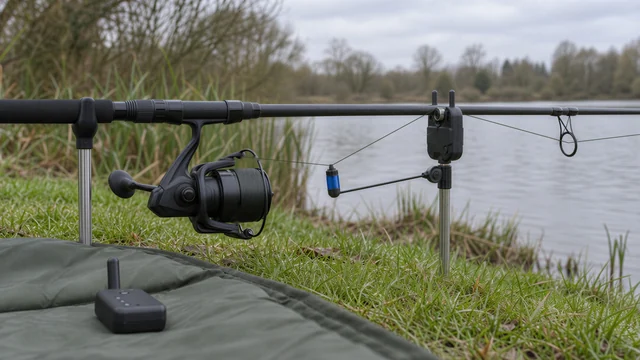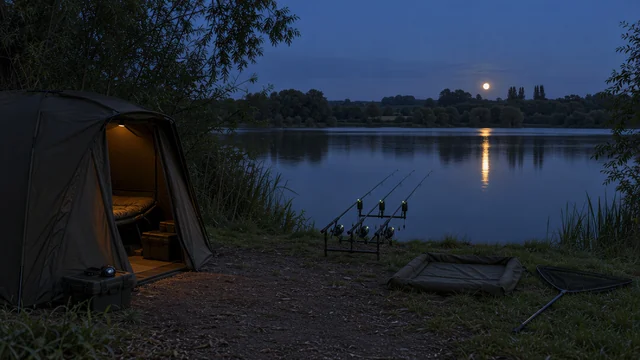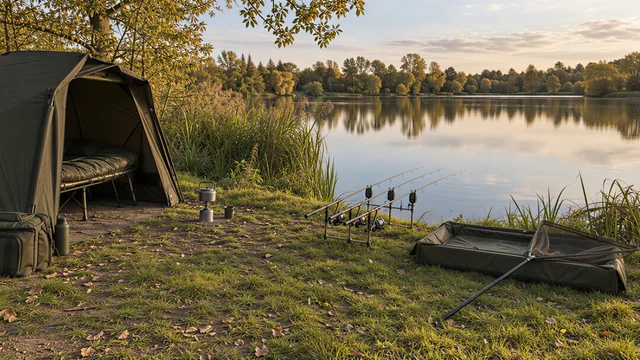
For a first carp session you need two rods and reels, bite alarms on a pod or bank sticks, a 42 in landing net, an unhooking mat or cradle, a few ready-tied rigs and leads, bait, and a valid rod licence. Everything else can wait.
Start with the paperwork
Before any kit, sort out the two things that let you fish legally.
- A rod licence. In England and Wales anyone aged 13 or over needs a rod fishing licence from the Environment Agency, bought online through GOV.UK: one licence covers both countries. Licences for 13 to 16 year olds are free, but they still have to be registered. A standard coarse licence covers up to two rods, and there is a separate licence for three. Wales has some local byelaws of its own, so check the rules for the water before you go. Northern Ireland has its own rod licences.
- A ticket or membership. Every lake belongs to someone: a club, a syndicate or a day-ticket fishery. Buy your ticket before you set up, and read the fishery rules. They're often posted at the gate or on the fishery's website.
Fisheries set their own rules on top of the law. Common ones are a minimum landing net size, a compulsory unhooking mat or cradle, no braided main line, barbless hooks only, and a limit on the number of rods. Turn up with the wrong kit and you may not be allowed to fish.
Rods and reels
For a first set-up, two matching rods are better than three mismatched ones. A 12 ft rod with a 3 lb test curve covers most UK lakes. It casts a normal lead comfortably to 80 or 100 yards and still bends nicely when a fish is close in. On small, tight waters a 10 ft rod is easier to handle.
Pair each rod with a freespool or big-pit reel. Freespool reels have a lever that lets a running fish take line without pulling the rod in, which makes them the simpler choice for beginners. Big-pit reels have a larger spool that casts further, and you fish them with the drag set light.
Load the reels with 12 to 15 lb monofilament. It stretches, so it forgives mistakes when you're playing a fish, and almost every fishery allows it.
Bite indication
- Bite alarms. One per rod. They beep when line moves. See choosing bite alarms for what the features do.
- Indicators. Swingers or hangers clip onto the line below the alarm and show whether a fish is moving towards you or away.
- Rod pod or bank sticks. A pod stands on any surface, including wooden swims. Bank sticks push into soft ground and are lighter to carry.
Landing and handling
Don't treat this kit as optional. It protects the fish, and most fisheries check for it.
- Landing net. A 42 in net is the usual minimum. A smaller net makes landing a big carp much harder.
- Unhooking mat or cradle. A thick padded mat or a raised cradle keeps the fish off hard ground. Many waters insist on a cradle.
- Carp care kit. Forceps to remove the hook, antiseptic for the hook hold, and a bucket of lake water to keep the fish wet. See carp care on the bank.
Terminal tackle
Terminal tackle is everything at the business end. Keep a small box with:
- Size 6 wide-gape hooks and a spool of coated braid for hair rigs
- Safety lead clips or helicopter kits, and 3 to 4 oz leads (see lead clip, helicopter or inline)
- Anti-tangle sleeves, size 8 swivels, a baiting needle and boilie stops
- PVA bags or mesh for small parcels of bait round the hook
- A pair of scissors or braid cutters
Tie a few rigs at home, before you go. Tying knots on a windy bank with cold hands is where most beginners lose their first hour.
Bait
You don't need a huge quantity. For a day session, a kilo of boilies, a bag of pellets and some sweetcorn will cover most situations. Use one or two baits as hookbaits and a mix of the rest as freebies around them.
Comfort
A day session needs a chair, waterproofs, a hat and food. For a night you'll add a bivvy (a fishing tent), a bedchair, a sleeping bag rated for the season, and a head torch with a red light setting, which won't spook fish or dazzle the angler in the next swim.
Where to spend and where to save
| item | spend | why |
|---|---|---|
| Landing net, mat or cradle | mid | Fish welfare, and fisheries check them |
| Hooks | mid to premium | Sharp, strong hooks land fish. Cheap ones blunt or open out |
| Main line | mid | A line that breaks under pressure loses fish and can leave rigs in them |
| Rods and reels | budget to mid | Entry-level rods and reels catch plenty of carp |
| Bite alarms | budget | Basic alarms do the job. Upgrade later if you fish a lot of nights |
| Bivvy and bedchair | budget to mid | Only once you know you enjoy night fishing |
Second-hand kit is common in carp fishing, because anglers upgrade often. Rods, reels, pods and bivvies buy well used. Buy hooks, line and anything that touches the fish new.
Questions
Do I need a rod licence to fish for carp?
Yes, in England and Wales anyone aged 13 or over needs an Environment Agency rod fishing licence, bought online: one licence covers both countries. Northern Ireland has its own rod licences. You'll also need a day ticket or club membership for the water.
How many rods should I use for my first session?
Two is plenty. A standard coarse licence covers up to two rods, and two is easier to manage while you learn to cast, set up and play fish. Check the fishery rules too, as some limit rods.
Do I really need an unhooking mat?
Yes. Almost every carp fishery insists on a padded mat or cradle, and many won't let you fish without one. It protects the fish from hard or stony ground while you unhook it.
Can I use my coarse fishing rods for carp?
For small carp on a commercial pond, a strong feeder rod can work. For bigger fish, longer casts or snaggy swims, a carp rod of around 12 ft and 2.75 to 3 lb test curve is safer and far easier to land fish on.
What size landing net do I need for carp?
A 42 in net is the usual choice. It's big enough for any carp you're likely to hook, and many fisheries set it as the minimum size.
Sources
- Buy a rod fishing licence, GOV.UK
- Freshwater rod fishing rules: tackle you can use, GOV.UK
- Angling rod licences explained, nidirect