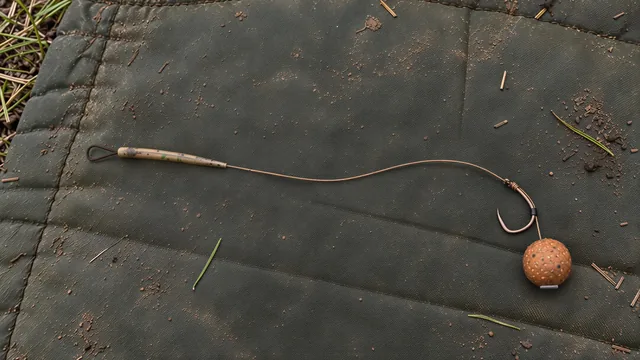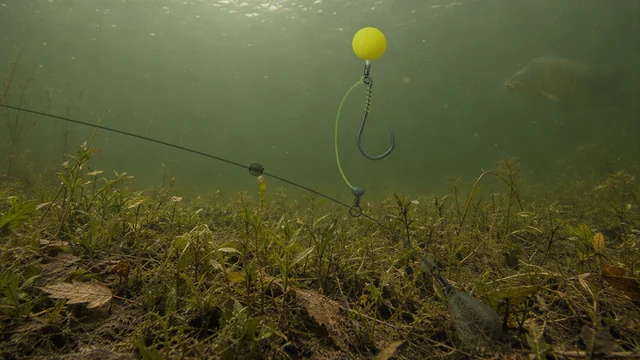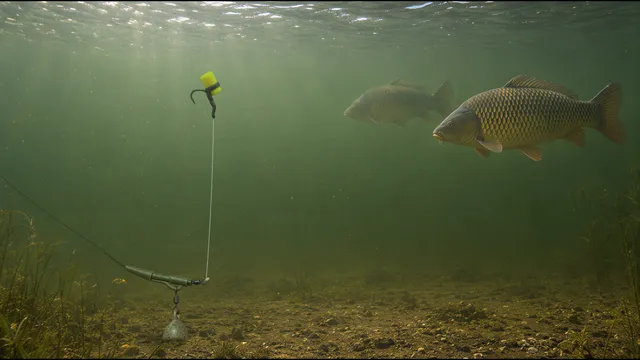
Use a lead clip for most fishing on firm or lightly weeded bottoms, a helicopter set-up for chods and for casting over soft silt or weed, and an inline lead for strong hook-setting on clean ground. Whichever you use, the lead must be able to come off if the line breaks.
Why the lead set-up matters
The lead does two jobs. It gets the rig out to the spot, and on most carp rigs it also sets the hook. When a carp picks up the bait and moves off, the weight of the lead pulls the hook into its lip before the fish knows what has happened. That's called a bolt effect.
There are three main ways to attach the lead: a lead clip, a helicopter and an inline lead. Each suits different lake beds and different rigs. All three can be fished safely, and all three can be dangerous if they're set up badly.
Lead clip
A plastic clip on the end of your main line or leader. The hooklink swivel pushes into the front of the clip, the lead hangs on the clip's arm, and a tail rubber pushes over the ribbed tail of the clip to close the arm and hold the lead on.
- Best for: fishing over weed and general use. It's the most common set-up in UK carp fishing.
- Its big advantage: the lead can drop off. Push the tail rubber on lightly and the lead comes off when a fish runs into weed or snags, so you play the fish, not a heavy lead buried in weed.
- Watch out for: tail rubbers pushed on so hard the lead can never come off. Many fisheries ask you to fish it so the lead drops.
Helicopter
The lead sits at the very end of the leader, and the hooklink is attached above it on a swivel that spins between two beads. In flight the lead goes first and the rig trails behind, spinning like helicopter blades, which is where the name comes from.
- Best for: long-range casting with almost no tangles, and fishing over silt or weed. Set the top bead higher and the rig settles on top of whatever the lead sinks into.
- The rig it's built for: the chod rig, which must only be fished on a helicopter.
- Watch out for: anything that stops the hooklink sliding off the top of the leader if the main line breaks. The top bead must be able to pull off.
Inline lead
The main line runs through a tube in the centre of the lead. The hooklink swivel pushes into a rubber insert at the bottom of the lead.
- Best for: the strongest bolt effect, because the fish feels the full weight of the lead straight away. Very good on clean, firm lake beds, and with short hooklinks and PVA bags.
- Watch out for: it doesn't drop off in weed, so it's a weaker choice on very weedy waters. If the line breaks, the swivel must be able to pull out of the insert so the lead comes free.
Which one to use
| Lake bed | First choice | Why |
|---|---|---|
| Clean gravel or clay | Inline or lead clip | Strong bolt effect, and the rig lies flat |
| Light weed | Lead clip | The lead can drop if a fish goes into weed |
| Thick weed or deep silt | Helicopter | The rig settles on top, especially with a chod |
| Long range | Helicopter | Casts furthest and tangles least |
| PVA bags | Inline or lead clip | Short hooklinks and a solid bag sit neatly |
Lead weight and shape
Most carp anglers use leads of 2.5 to 4 oz. Lighter leads land more quietly in the margins. Heavier leads cast further and give a stronger bolt effect.
Shape matters too. Flat leads stay put on slopes and bars. Pear and distance leads cast further. Grippa-style leads with bumps hold on gravel and in flowing water.
Use the lead to learn the lake bed. When it lands, keep the line tight and feel how it hits bottom. A sharp "donk" means gravel or clay. A soft thud means silt or weed. Then choose your set-up to match. See reading a lake with a marker rod.
Whichever set-up you use, the rule is the same: if your main line breaks, the fish must not be left towing the lead. On a lead clip, the lead and leader must be able to come free. On a helicopter, the hooklink must slide off the top of the leader. On an inline lead, the swivel must pull out of the insert. Test it in your hands before every session.
Questions
Which lead set-up is best for beginners?
A lead clip. It's simple to set up, casts well, works on most lake beds and can release the lead if you hook a fish in weed or the line breaks.
Should the lead come off when I get a take?
Many anglers set the tail rubber so the lead only drops when a fish gets weeded or the main line breaks. In heavy weed some push the rubber on lightly so the lead drops on every take. Check what your fishery requires.
How heavy should my lead be?
Around 3 to 4 oz suits most carp fishing at normal range. Go lighter for close-range or margin fishing to cut down on disturbance, and heavier only if you need extra casting distance or a stronger bolt effect.
Why is the helicopter set-up used with chod rigs?
Because the hooklink can slide up the leader and settle on top of weed or silt, whatever the lead sinks into. The top bead must be able to pull off so a fish can never be tethered if the line breaks.
Is an inline lead safe?
Yes, as long as the lead can slide off the end of the leader or tubing if the main line breaks. Avoid any set-up where a knot or a fixed stop prevents the lead from coming free.