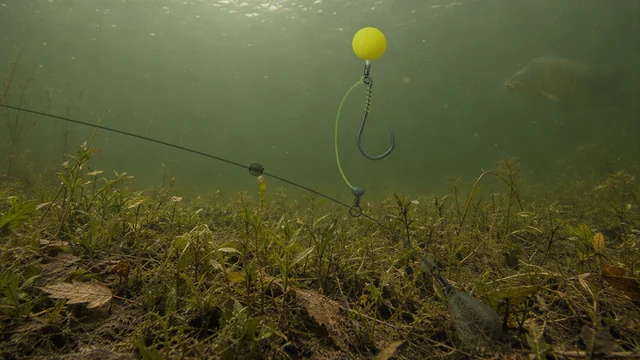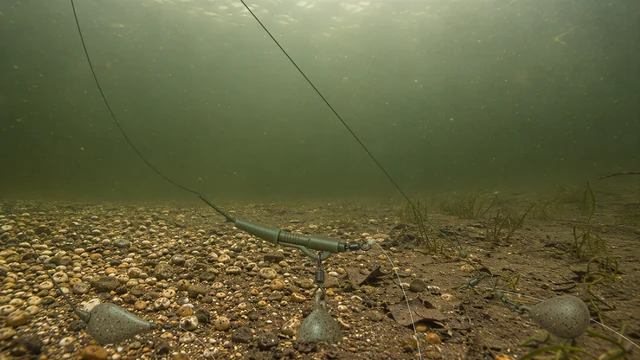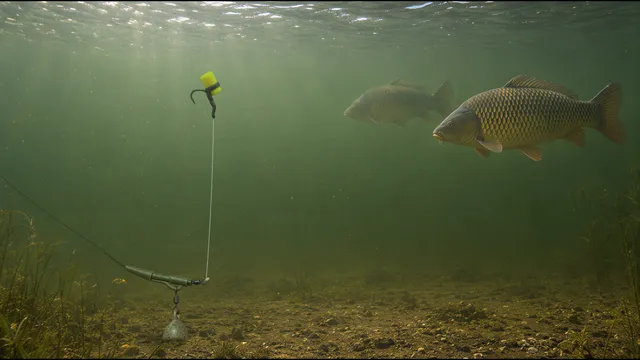
Tie the bait to a short hair that leaves the back of the hook at the bend, held flat against the shank by a 1 to 2 mm silicone sleeve, so the bait hangs just below the bend. The bare hook catches in the carp's lip when it tries to blow the bait out.
Why the hair rig works
Before the hair rig, carp anglers pushed the hook through the bait. Carp are cautious feeders: they suck a bait in, feel the weight and stiffness of a hook buried in it, and blow it straight back out. The hair rig, worked out on English waters in the late 1970s, takes the bait off the hook and hangs it on a short length of line (the hair) instead.
Now when a carp sucks in the bait, the bare hook comes in behind it. It feels natural, and when the fish tries to eject it the hook catches in the bottom lip. That's why almost every carp rig you'll see is a variation on this one idea.
The parts
- Hook. A size 6 wide-gape pattern suits most baits from 15 to 20 mm. Go to a size 4 for big baits or a size 8 for small ones.
- Hooklink. About 15 cm (6 in) of braid, 15 to 25 lb, from the hook to the loop at the other end.
- Silicone sleeve. A 1 to 2 mm piece of silicone tube at the start of the bend. It holds the line flat against the back of the shank and sets where the hair leaves the hook.
- Hair. The tail of the hooklink, carried on past the sleeve and finished with a small loop. No separate line is needed.
- Bait and stop. A boilie threaded on the hair loop with a baiting needle, pulled up so it covers the loop knot, with a bait stop lying flat across the base of the bait.
- Loop and shrink tube. A figure-of-eight loop at the other end, under about 4 cm of tapered shrink tube. The loop goes on a quick-change swivel on your lead set-up, and the stiff, tapered tube helps stop the hooklink tangling.
How to tie it
- Cut about 30 cm of braid and tie a small overhand loop in one end. This is the end of the hair.
- Hook the loop with a baiting needle, push the needle through your boilie and pull the loop through. Put a bait stop through the loop so it lies flat across the base of the bait, then pull the bait back so it covers the loop knot.
- Cut a 1 to 2 mm piece of silicone tube. Push the hook point through it and slide it round the bend to where the bend starts.
- Lay the line along the back of the shank and push it under the silicone sleeve, so the hair comes out of the sleeve towards the bait.
- Set the hair. Slide the line through the sleeve until the bait hangs just below the bend of the hook.
- Keeping the line flat along the back of the shank, pass it through the eye and tie it to the eye with a grinner or palomar knot. Wet the knot before you pull it tight.
- Thread about 4 cm of tapered shrink tube onto the free end, thin end first, so the thin end faces the hook.
- About 15 cm (6 in) from the eye, tie a figure-of-eight loop.
- Slide the shrink tube down over the knot so only the loop sticks out of the end, then steam it so it shrinks tight.
Test every rig before it goes in the water. Pull the bait gently towards the bend. If the hook point flips round and digs into your finger, the rig is working. If the bait drags the hook flat, shorten the hair.
Common mistakes
Hair too long
A long hair lets a carp take the bait without the hook ever entering its mouth. If you're getting short twitches and no runs, take a few millimetres off the hair.
Blunt hooks
A hook that has been dragged across gravel can lose its point after one cast. Check the point on your thumbnail: a sharp hook catches straight away, a blunt one slides. Change it rather than reuse it.
Tangles
A soft hooklink can wrap round the lead in flight. The tapered shrink tube over the loop helps; for more, use a stiffer hooklink, a PVA bag or stick, or a small piece of PVA foam on the hook when you cast.
Sleeve in the wrong place
If the sleeve slides up the shank the hair leaves the hook too high and the bait masks the point. Keep it right at the start of the bend, and check it hasn’t moved after every fish.
When to use something else
The hair rig is the right choice on a clean, firm lake bed such as gravel or hard clay. In thick weed or deep silt a bottom bait can disappear, and a chod rig with a pop-up sits on top instead. When carp are feeding up in the water, try a zig rig. Whatever rig you use, the lead arrangement matters too: see lead clip, helicopter or inline.
Always use a lead set-up that lets the lead come off if the main line breaks, so a fish is never left towing it. Many fisheries also ban barbed hooks or certain rigs, so check the rules before you tie up.
Questions
How long should the hair be?
Long enough for the bait to hang just below the bend of the hook. Set it by sliding the line through the silicone sleeve before you tie it to the eye. Shorten it if you get twitches without runs.
What hook size for a hair rig?
Size 6 suits most baits from 15 to 20 mm. Use a size 4 for bigger baits and a size 8 for small ones.
What does the silicone sleeve do?
A 1 to 2 mm piece of silicone tube at the start of the bend holds the line flat against the back of the shank. It sets where the hair leaves the hook, so the bait hangs just below the bend every time.
Do I need shrink tube?
On this rig it goes over the figure-of-eight loop at the end of the hooklink. About 4 cm of tapered shrink tube, steamed tight, stiffens that end and helps stop tangles.
What knots do I need for a hair rig?
A small overhand loop for the hair, a grinner or palomar to tie the line to the hook eye, and a figure-of-eight loop at the other end.