Clip your spod rod to the same distance as your hook rod, fill the spod or spomb two-thirds to three-quarters full, and cast every load at the same far-bank marker so the bait lands in a tight patch around your hookbait.
Why spod at all
Within throwing range, a catapult or throwing stick puts bait where you want it. Past about 40 yards, loose bait spreads out and falls short. A spod or spomb is a rocket-shaped container you cast on a dedicated rod, so you can put particles, pellets and crumbed boilies exactly on your spot at 80 yards or more.
The aim isn't just to get bait out there. It's to get it in a tight area around your hookbait, so carp feeding on the free offerings find the hook among them.
Spod or spomb?
| Type | How it works | Best for |
|---|---|---|
| Spod | Open-ended tube with a buoyant nose. It flips over on the surface and empties as you lift the rod. | Particles, hemp, liquids and wetter mixes. |
| Spomb | Clamshell that stays shut in flight and springs open when it hits the water. | Accuracy and dry-ish mixes. Less spillage on the cast. |
Both do the same job. Many anglers start with a spomb because it's forgiving: it doesn't spray bait on the way out, so a slightly wonky cast still lands a neat pile.
The kit
- Spod rod. A 12 to 13 ft rod with a 4.5 to 5 lb test curve, built to cast a loaded spod again and again.
- Big-pit reel. A large spool helps line flow off and gives you a fast retrieve.
- Spod braid. 0.18 to 0.20 mm braid casts further than mono and lets you feel the spod hit the clip.
- Shock leader. A tapered or 30 to 40 lb leader takes the strain of the cast. Spodding without one is the classic way to crack off and leave a spod floating in the lake.
- Finger stall. Braid on a hard cast can cut your finger. A stall or glove protects it.
How to bait a spot
- Find your spot with a marker rod and clip up to it. Count the wraps on your distance sticks.
- Wrap the spod rod to the same distance and clip the line into the reel's line clip.
- Pick a far marker on the horizon in line with your spot. Every cast aims at it.
- Fill the spod two-thirds to three-quarters full. Overfilling makes it heavy, cuts distance and can spill on the way out.
- Cast with a smooth, full compression, not a jerk. Feather the line as it reaches the clip so the spod drops neatly instead of slamming in.
- As it lands, lift the rod sharply to empty it, then wind back in quickly and repeat.
- Cast your hookbait to the same clip and the same far marker. It lands in the middle of your bait.
Count your spods. Twenty spods of a 50/50 hemp and pellet mix is a reasonable start for a day in summer. You can always add more, but you can't take bait out once it's in.
Keeping it tight
Accuracy matters more than distance. A bed of bait scattered across 20 square yards gives carp lots to feed on and little reason to find your hookbait. Watch where each spod lands. If it drifts off line, adjust your next cast rather than adding more bait to correct it.
Wind and drag affect the spod more than the hookbait, so check both land together. The clip keeps the distance right. Your far marker keeps the line right.
What to put in it
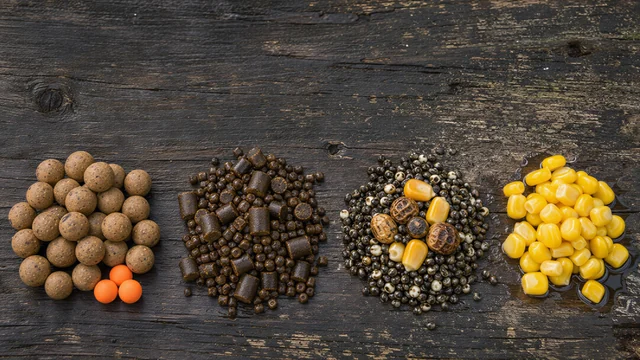
- Hemp and particles. Small, cheap, and keep carp grubbing about for a long time. Particles must be properly prepared: soaked and boiled until soft. Dry or undercooked particles can swell inside a fish and harm it.
- Pellets. Break down and release attraction. Mix sizes for a varied bed.
- Chopped or crumbed boilies. Match your hookbait and add bigger food items.
In cold water, go easy. See winter carp for why less bait catches more when the temperature drops.
Spodding is noisy and can spook fish in a neighbour's swim. Bait up when you arrive and keep top-ups short. Never spod into someone else's water. Some fisheries limit or ban spodding, especially at night, so check the rules first.
Questions
What's the difference between a spod and a spomb?
A spod is an open-topped rocket that turns over and empties when it hits the water. A spomb is a hinged, closed shell that stays shut in flight and springs open on impact. Spombs fly further and hold sloppier mixes and liquids well; spods are cheaper and simple.
How much bait should I spod out?
It depends on the season, how many fish are in the lake and how many anglers are baiting. Start smaller than you think, especially on a new water, and top up after bites. In cold water a few spods or none at all is often right.
Why use braid on a spod rod?
Braid has almost no stretch, so it casts further and lets you feel the spod hit the water. It also stops cleanly at the line clip every time, which keeps your baiting accurate.
Do I need a shock leader for spodding?
Yes, if you're casting a loaded spod hard. A heavy spod puts a lot of force on the line at the moment of casting, and a leader stops crack-offs that would leave a spod floating in the lake.
Will spodding scare the carp?
It can, especially in shallow or quiet water. Bait up before you put your rigs out, keep the number of loads sensible, and on pressured lakes consider baiting with a throwing stick or bait boat instead where the rules allow.