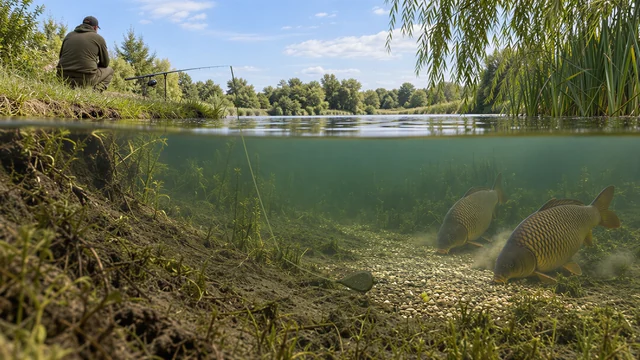
Cast a heavy marker lead with a float on braid, then drag it back slowly: a smooth pull means silt, a juddering tap means gravel, and the float tells you the depth. Look for bars, plateaus and clean spots, because carp patrol and feed on them.
Why features matter
Carp don't feed evenly across a lake. They follow routes, patrol edges and return to the same spots, because that's where the food is. Natural food such as bloodworm, snails and shrimp collects in particular places: along the base of a gravel bar, on a clean plateau, in soft silt beside weed.
A marker rod lets you see the lake bed without seeing it. You cast a buoyant float on a heavy lead, feel what the lead drags across, and pop the float up to measure depth. Ten minutes of careful marker work tells you more about a swim than a day of guessing.
The kit
- Marker rod. A stiff 12 ft rod with a fast action, so you can feel every bump through the tip. A spare carp rod works to start with.
- Braid main line. Braid doesn't stretch, so it carries vibrations from the lead straight to your hand. 20 to 30 lb is typical, with a mono shock leader for casting.
- Marker float. A buoyant float with a bright top, on a swivel that runs freely on the line.
- Feature-finding lead. A 3 to 4 oz lead with a ribbed or studded body, which grips and bumps over the bottom so you can feel the texture.
- Distance sticks. Two bank sticks set a known distance apart (often 6 ft), used to measure how far out a spot is by wrapping line around them.
How to read the lake bed
- Set up the float so it sits right next to the lead, with a bead and swivel between them. The lead and float go out together.
- Cast to a far marker on the opposite bank, such as a tree, so every cast follows the same line. Let the lead sink on a tight line and count it down.
- Once it lands, point the rod at the lead and pull it slowly back towards you by sweeping the rod sideways. Keep the line tight and feel what comes through the tip.
- Stop when you feel a change, such as a firm knock or the lead suddenly locking up. Reel down to the lead so the float is pinned to the bottom.
- Let line off in 1 ft steps, counting as you go, until the float pops up on the surface. The number of feet is the depth at that spot.
- Repeat along the same line, dragging a few yards at a time, and note depth and texture at each stop. Build up a picture of the swim before you cast a hookbait.
What the lead is telling you
| Feel | What it is | What it means |
|---|---|---|
| Sharp, rattly knocks | Gravel | Clean, firm ground. Often a feeding spot, especially if it feels polished. |
| Smooth, steady drag | Clay or firm silt | Good for a bottom bait. Carp often feed hard on firm silt. |
| Soft, heavy pull with no knocks | Deep silt | Can hold food, but a bottom bait may sink in. Think about a pop-up or chod rig. |
| Lead locks, then pings free | Weed | Look for clear gaps in it. Weed edges are classic patrol routes. |
| Float rises in fewer feet | A bar or plateau | Shallower ground. Fish the top, the base, or the slope on either side. |
Turning it into a spot
Once you've found something you like, leave the float popped up over it and clip the line into the reel's line clip. That clip is now your distance. Walk the line out round your distance sticks to count the wraps and write it down, so you can find the same spot again next time.
Clip your rod and your spod rod to the same number of wraps, and every cast will land where the float sits. Then reel the marker in before you start fishing, so it isn't left sitting in the swim.
The best spot is often the change, not the feature itself: where gravel meets silt, the base of a bar, or a clear patch in weed. Carp follow edges.
Courtesy and the fish
A marker lead crashing in repeatedly is noisy. Do your marker work when you arrive, keep the number of casts down, and stop once you've found what you need. Never cast into or across a neighbour's water, and ask before working near a shared boundary.
Some fisheries ban marker rods or only allow them at set times, and some ban braid. Read the rules before you set up, and if you're unsure, ask the bailiff.
Questions
Why use braid on a marker rod?
Braid has almost no stretch, so every bump and tap from the lead travels straight up the line to the rod tip. Mono stretches and hides that information, which is why marker rods are almost always loaded with braid.
How do I measure the depth with a marker float?
Cast out, tighten up to the lead, then let line off a foot at a time until the float reaches the surface. Count the feet you released and that is the depth at that spot.
What does a 'drop' on the lead feel like?
When you lift the rod with the line tight, the lead lands back on the bottom. A crisp 'donk' means a firm, clean bottom. A soft, slow landing with no knock usually means silt or weed.
Do I need to use a marker rod on every session?
No. Once you know a swim well you can find your spots with a plain lead and distance sticks. A marker is most useful on a new water, after weed growth changes, or when you want to find a new feature.
Will marker work scare the carp?
Repeated heavy casts can push fish away for a while, especially in shallow water. Do your marker work early, keep it to as few casts as you need, and never cast into or across another angler's swim.