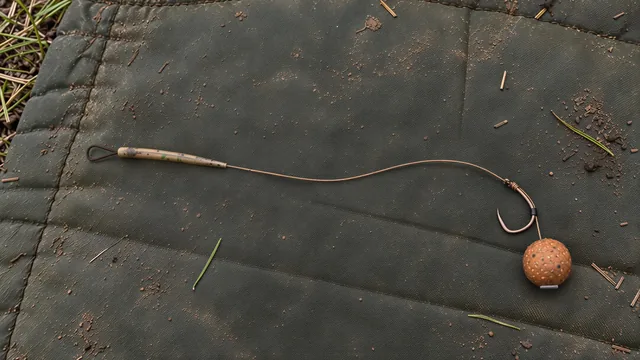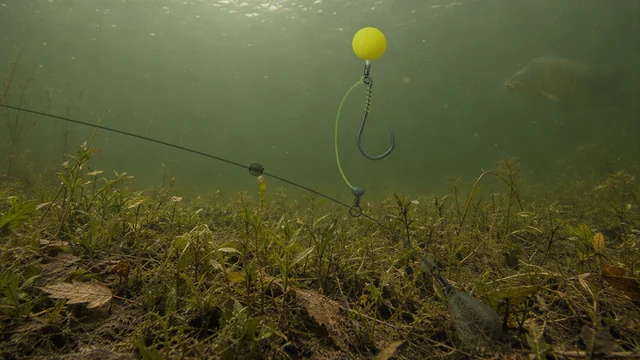
A Ronnie rig is a pop-up rig where the hook eye is clipped onto a swivel at the end of the hooklink, so the hook spins freely and turns to catch hold whichever way the carp moves. The pop-up sits on a small ring swivel on the shank. Fish it over clean, firm ground, balanced to sink slowly.
What the Ronnie rig does
The Ronnie rig, also called the spinner rig, is a pop-up rig built around one idea: the hook should be free to turn. Instead of tying the hooklink to the hook, you clip the hook eye onto a small quick-change swivel at the end of the hooklink, held at an angle by a piece of shrink tube. The pop-up is tied to a second, tiny ring swivel on the hook shank.
When a carp sucks in the bait, the hook can spin round on the swivel to face whichever way it needs to. As the fish tries to blow it out, the point turns down and catches in the bottom lip. The bait sits just off the bottom, so it is easy for a feeding carp to find and pick up.
When to use it, and when not
| Lake bed | Ronnie rig? | Why |
|---|---|---|
| Clean gravel or firm clay | Yes | The bait sits just above a firm bottom where the hook won't mask. |
| Light debris or short silkweed | Often | Set the bait a little higher with less putty. |
| Thick weed | No | The hook gets buried. Use a chod rig. |
| Soft, deep silt | No | The rig sinks in with the lead. A chod sits on top instead. |
Items required
- Hook: curved-shank or long-shank pattern, out-turned eye, size 4 to 6.
- Swivels: a size 11 quick-change (spinner) swivel for the hook eye, and a micro ring swivel or small rig ring for the pop-up.
- Hook bead or stop: to trap the micro ring swivel on the shank.
- Hooklink: 15 to 20 cm of stiff boom material or coated braid, 20 to 25 lb.
- Pop-up of 12 to 15 mm, tungsten putty and a size 8 swivel for the lead end.
- Shrink tube, a kettle for steam and a rig puller.
How to tie it
- Slide a 1 cm piece of shrink tube onto the hook shank. Don't shrink it yet.
- Open the quick-change clip of the size 11 swivel, hook the eye of the hook onto it and squeeze the clip shut.
- Slide the shrink tube back up over the hook eye and the swivel's clip together, then steam it so it grips both and holds the hook at an angle to the swivel.
- Thread a micro ring swivel onto the hook point and push it round the bend onto the shank, then push a hook bead on after it. The bead sits on the bend side of the swivel, roughly opposite the point, so the swivel can turn but can't slide off.
- Tie the pop-up to the micro ring swivel with bait floss.
- Tie the hooklink to the other ring of the size 11 swivel with a grinner knot. Wet the knot and tighten it on a rig puller.
- Tie a size 8 swivel to the other end of the hooklink. If you're using stiff boom material, steam it straight.
- Mould a small piece of tungsten putty round the swivel just below the shrink tube. Add or remove putty until the rig sinks slowly with the hook point just clear of the bottom.
Test the balance in the margin or a bucket. A Ronnie fishes best when it sinks slowly and settles gently, with the bait standing a few centimetres up. If it shoots to the bottom, take a little putty off.
Fishing it
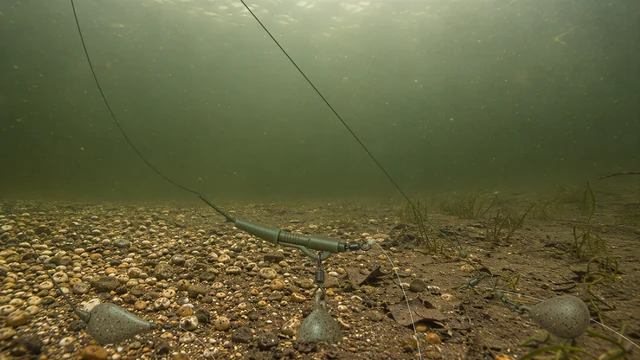
Fish the Ronnie on a lead clip or a helicopter set-up: see lead clip, helicopter or inline. Cast it to a spot you know is clean, such as a gravel patch found with a marker rod. Feel the lead down: a sharp "donk" through the rod means firm ground, which is where this rig belongs.
It works well as a single hookbait over a light scattering of boilies. Because the bait sits up, it is often found quickly by fish that are moving and grazing rather than feeding hard.
Common mistakes
The swivel doesn't spin
If the shrink tube or putty is packed round the swivel so tightly that it can't turn, or the hook bead pinches the pop-up's ring swivel, the rig loses its main advantage. You should be able to flick the hook round on the swivel with a fingertip.
Too much putty
Heavy putty pins the bait flat to the bottom. The rig then behaves like a stiff bottom-bait rig, and the hook point can catch on the lake bed.
Wrong spot
Most failed Ronnie sessions are on silt or weed. If the rig comes back dirty or covered in weed, switch to a chod or a hinged stiff rig.
Make sure the hook bead grips firmly, so the pop-up's ring swivel can't slide off the hook and leave a bare hook in a fish. Always fish the rig on a set-up that lets the lead come off if the main line breaks. Some fisheries ban certain pop-up rigs, so check the rules before you tie one.
Questions
Why is it called a Ronnie rig?
It is a modern version of the older spinner rig, and the nickname spread through the carp scene in the 2010s. Spinner rig and Ronnie rig mean the same thing.
What hook should I use for a Ronnie rig?
A curved-shank or long-shank pattern with an out-turned eye, usually size 4 to 6. The longer shank gives the pop-up's ring swivel room to sit and makes the hook turn quickly.
Can I fish a Ronnie rig over weed or silt?
It is not a good choice there. The rig sits close to the bottom, so the hook can mask in weed or sink into silt. A chod rig suits those spots better.
How high should the pop-up sit?
Most anglers set it so the bait sits a few centimetres off the bottom, using tungsten putty round the swivel at the hook eye. Test it in the margin: it should sink slowly and settle with the hook point just clear of the bottom.
Is the Ronnie rig safe?
Yes, when it is fished on a lead clip or helicopter set-up that lets the lead come off if the main line breaks, and when the pop-up's ring swivel is held firmly by a hook bead so it cannot slide off the hook. Check your fishery's rules, because some waters ban certain pop-up rigs.