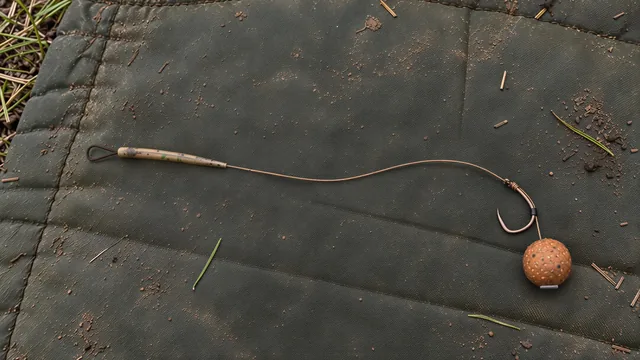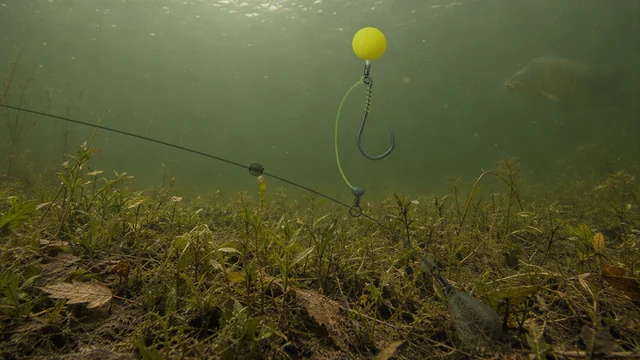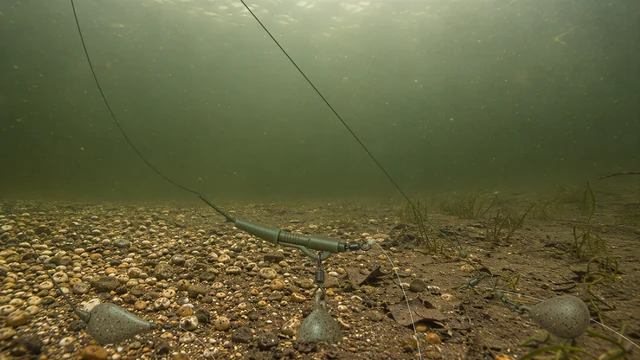
A hinged stiff rig joins a stiff boom to a short stiff hook section with a small rig ring, so the pop-up can rise and turn as a carp feeds and the hook flips into the bottom lip. Use it over clean or lightly covered ground where a long stiff rig would tangle and a chod would sit too high.
Why a hinge?
The hinged stiff rig is made of two stiff sections joined by a small rig ring. A boom runs from the lead to the ring, and a short hook section runs from the ring up to a pop-up. Neither part bends, but the joint between them does.
That joint is the clever bit. When a carp tips up and sucks at the pop-up, the hook section swings freely on the ring and is drawn straight in. When the fish tries to blow it out, the stiff boom resists and the hook turns and catches. The stiffness also keeps the rig from tangling on the cast, even at long range.
Hinged rig or chod?
| Hinged stiff rig | Chod rig | |
|---|---|---|
| Best ground | Clean gravel, clay, light debris | Weed, silt, leaves |
| Bait height | Low, set by putty at the hinge | High, set by the bead on the leader |
| Lead set-up | Lead clip or helicopter | Helicopter only |
| Difficulty | More steps to tie | Quicker to tie |
Items required
- Boom: 15 to 25 cm of stiff boom material or stiff fluorocarbon, 20 to 25 lb.
- Hook section: about 8 cm of stiff chod filament.
- Hook: a chod or curved pattern, size 6 to 8, with an out-turned eye.
- Small rig rings (two), a size 8 swivel, a pop-up and tungsten putty.
- Floss, a lighter, a kettle for steam and a rig board.
How to tie it
- Pass the end of the chod filament through the back of the hook eye, whip it six or seven times down the shank and pass it back through the back of the eye (a knotless knot).
- Thread a small rig ring onto the short tag end, pass the tag back through the eye to leave a small D behind it, and blob the tag with a lighter. The ring on the D is where the pop-up goes.
- Measure 3 to 5 cm along the filament and tie it to a second rig ring with a figure-of-eight knot or a grinner. This ring is the hinge.
- Steam the hook section into a gentle curve so the hook points slightly back towards the hinge.
- Tie one end of the boom to the hinge ring with a grinner knot. Wet the knot and tighten it on a rig puller.
- Tie a size 8 swivel to the other end of the boom, then steam the boom dead straight.
- Tie the pop-up to the ring on the D with floss so it sits just clear of the hook.
- Mould tungsten putty around the hinge ring until the rig sinks with the boom on the bottom and the pop-up standing up from the hinge.
Tie hinged rigs at home and keep them straight on a rig board. The stiff boom stays straight and the hook section keeps its curve, which saves a lot of steaming on the bank.
Fishing it
The hinged rig is a good choice at range and for single hookbaits over a light scattering of freebies. Because it is stiff and tangle-free, you can cast it a long way and still be confident it landed right.
Fish it on a lead clip or a helicopter: see lead clip, helicopter or inline. Find a firm spot with a marker rod first. Over thick weed or deep silt, switch to a chod rig.
Common mistakes
Soft material
If the boom or hook section bends easily, there is no hinge, just a floppy rig that tangles. Use proper stiff materials and replace them once they lose their shape.
No putty at the hinge
Without putty the whole rig can float up off the bottom. The hinge needs to be pinned down so the pop-up stands up from it.
Hook section too long
Over about 5 cm, the hook section starts to behave like a short chod and loses the quick turning action. Keep it short.
Always fish a hinged rig on a set-up where the lead can come off if the main line breaks. Check the blob behind the hook eye is firm before every cast. Some fisheries don't allow stiff pop-up rigs, so check the rules first.
Questions
What is the difference between a hinged stiff rig and a chod rig?
A chod rig is a single short stiff section that slides on a leader, so it settles on top of weed or silt. A hinged rig has a fixed boom from the lead and a separate hook section, so it presents the bait lower and further from the lead, which suits cleaner ground.
How long should the boom and hook section be?
A boom of about 15 to 25 cm and a hook section of about 3 to 5 cm are common starting points. Shorten the boom on choppy bottoms and lengthen it for very wary fish.
What material should I use?
Stiff fluorocarbon or a dedicated stiff boom material for the boom, and stiff chod-style filament for the hook section. Both need to hold their shape: a soft material removes the hinge effect.
Why put putty at the hinge?
A small blob of tungsten putty on the rig ring pins the hinge to the bottom, so the pop-up stands up from that point. Without it the whole rig can lift and tangle.
Is the hinged stiff rig hard to tie?
It takes a few more steps than a hair rig, mostly steaming and shaping the stiff sections. Tie a batch at home and store them straight in a rig board so they keep their shape.