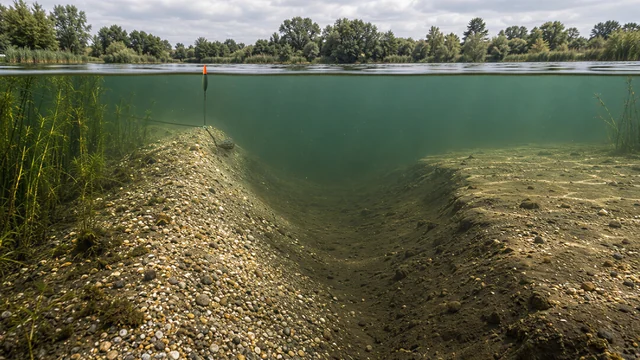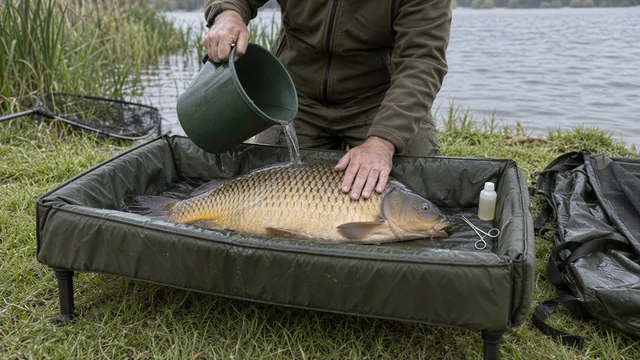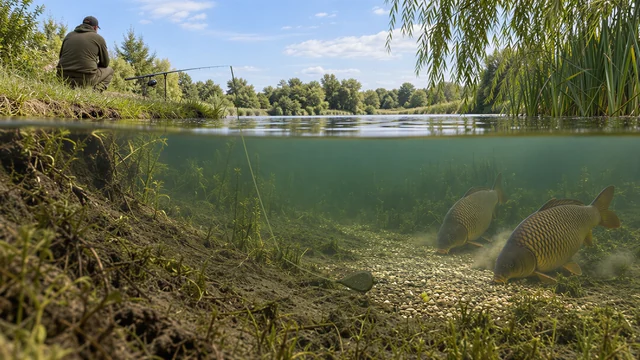
Feed floating baits such as mixers little and often until carp are taking them confidently, then cast a controller float well past the fish and draw the hookbait back into the feeding area.
Why surface fishing works
On warm days, carp often rise up to cruise and bask near the surface. They aren't interested in a bait on the bottom then, but they'll happily take food floating above them. Surface fishing uses that. You get them feeding on free floating baits, then slip a hookbait in among the freebies.
It's also one of the most exciting ways to catch a carp, because you watch the whole thing happen. That also means a lot of it comes down to patience and watercraft rather than kit.
Items required
- Controller float. A weighted float that gives you casting distance and holds the hookbait in place. Pick one heavy enough to reach the fish, with some to spare.
- Floating baits. Dog biscuit mixers or floating pellets are the classic choice. Soak a few in a little water or a liquid attractor so they stay soft and sink later rather than hard.
- Hooklink. 6 to 10 lb, fine and supple, roughly 1 to 1.8 m (3 to 6 ft) long, shorter near weed or pads.
- Hook. A small, strong size 8 to 12 pattern.
- Floating mainline or a little line grease, so the line doesn't sink and drag the bait.
- Catapult and polarising sunglasses to see fish under the surface.
How to do it
- Walk the lake and find carp near the surface. Look for dorsal fins, swirls, and fish drifting just under the top in the sun.
- Pick a spot upwind of the fish so the wind carries the bait to them. Put out a pouch of mixers with the catapult.
- Keep feeding little and often. A few baits every minute or two is better than a big pile all at once.
- Wait until carp are taking baits confidently, coming up and slurping them without hesitation. This can take a while. Don't rush it.
- Thread the controller onto your mainline and tie on a small swivel that pushes into its base, then tie the hooklink and hook to the swivel. Put the hookbait on a band or a short hair.
- Cast well past the feeding fish, so the float doesn't land on their heads, then gently draw it back until the hookbait is among the free baits.
- When a carp takes the hookbait, wait until the line moves or the float goes, then lift into it smoothly. Striking at the first swirl usually pulls the bait away.
If carp keep taking every free bait except yours, your hooklink is probably too heavy or too short. Go lighter and longer, and make sure the hookbait drifts at the same pace as the freebies.
Choosing a controller
| Controller | Best for | Watch out for |
|---|---|---|
| Small, light | Short range, calm water, wary fish | Less casting distance, harder to see in a ripple |
| Medium | Most situations, 20 to 50 m | Make sure it sits upright in the water |
| Heavy | Long range or into the wind | Lands with a splash, so cast well past the fish |
Common mistakes
Casting too soon
If you cast before carp are competing for the free baits, you'll often spook them before they've settled. Let them build up confidence first.
Feeding too much
Too many free baits on the surface means your hookbait is one of hundreds. Feed just enough to keep the fish coming up.
Striking at the swirl
Carp often swirl at baits before taking them properly. Wait until the line or float moves before you lift.
Don't fish near snags, lily pads or overhanging trees you can't land a fish from. Use a hooklink strong enough to land the fish you're targeting, and check the fishery's rules on floating baits and dog biscuits.
For fishing on the bottom close to the bank, see margin fishing and stalking. For other warm-weather tactics, see summer carp.
Questions
When is the best time for surface fishing?
Warm, settled days from late spring to early autumn, when carp sit high in the water. Calm or lightly rippled water is easiest. Surface fishing rarely works in cold water.
What hooklink should I use for surface fishing?
A fine, supple hooklink of around 6 to 10 lb, often mono or fluorocarbon, roughly 1 to 1.8 m (3 to 6 ft) long from the float. Carp look up at the bait against the sky, so a lighter line helps.
How do I put the hookbait on?
Mixers are usually fitted with a small bait band, or glued or drilled and put on a short hair. A piece of cork or foam on the hair also works and stays afloat for longer.
Why do carp keep taking the free baits but not mine?
Usually the hooklink is too heavy or too short, or the hookbait is behaving differently from the freebies. Try a lighter, longer hooklink and make sure your hookbait drifts the same way as the loose feed.
Is surface fishing allowed everywhere?
Most waters allow it, but some ban dog biscuits or floating baits, or limit the amount you can feed. Check the fishery rules before you start feeding.